To be fair to Citrix, I'll start by saying that this appears to be a Microsoft bug. But that doesn't change the magnitude of what can only be described as a monumental clusterfuck - it doesn't matter who's at fault, the problem exists today and will exist in the forseeable future unless we as Citrix and Microsoft customers put the hard word on both companies, now. And that is the absolute intention of this post - not to rubbish Citrix or Microsoft, but to get a strong message out that this needs to be fixed yesterday.
As far as I'm concerned, if you're a big Citrix shop then there is no other choice for a broker - the integration with XenApp's Web Interface, the soon-to-be single client, and the power of ICA on the desktop... it's pretty much a no brainer if you have a lot of this technology in your estate already. And even more of a no brainer if your VDI users are on the end of a >100ms latency.
Except that it could cripple your support organisation.
There is a bug that manifests when an RDP connection is made to Session0 (ie, the console session) which effectively renders the PortICA stack inoperable after that connection is terminated. That is to say, when someone uses Remote Assistance to get support, they will not be able to reconnect to that desktop via ICA after the session is terminated without a reboot of the box. So what do Citrix recommend you do to avoid this problem? Disable RDP of course!
[EDIT] I didn't explain it very well above... connecting via RDP to the console of a machine running XenDesktop 2.0 results in (a) the ICA session terminating immediately and (b) the box rebooting automatically after the RDP session is terminated.
But since XenDesktop actually remotes the physical display of the machine, the console is completely black when viewed via the VI client or VI Web Access so you can't use that for remote support. And you can't shadow PortICA sessions like you can with server-side ICA sessions either. But you don't need remote assistance... do you?
Almost every large enterprise I have worked has a remote first line of support. And almost as common is the outsourcing of the 2nd line desktop support, ie the ppl who perpetuate sneakernet. And most of those large enterprises stopped paying for 3rd party remote support solutions long ago (a substantial saving for places with over 50K desktops). Remote Assistance is a critical tool, both for speedy case resolution and for keeping support costs down (those physcial bodies are way more expensive than the ones on the end of the phone), both of which make for happy users and a happy business. Well, happier users and business at least. And it all comes free with Windows XP.
Hence the Citrix recommended workaround for this problem of disabling RDP if you install XenDesktop is utterly ridiculous and untenable IMHO. After spending years worth of time and who knows how much money on training your users to use Remote Assistance, you now have to switch it off and find some other way to get the functionality? Might that be buying GoToAssist by any chance? If Citrix have any hope of a quick resolution to this problem, they had better start bundling that with the XenDesktop standard edition license. Or get the session shadowing capabilities that have been available in Presentation Server for many years into XenDesktop ASAP.
So getting back to where this post started, XenDesktop 2.0 in its current state may send you right back to the pre-XP days, where a physical body had to go to a users desk in order to observe, understand and resolve a problem. Or you had to pay through the nose for a 3rd party remote support tool.
I don't know which is sadder - the fact that a phsyical person may need to go to a physical desk to fix a problem on a machine that isn't physically there, or the irony that a company who prides themselves of providing remote access solutions could put us in this position.
Wednesday, 25 June 2008
Tuesday, 17 June 2008
New(ish) blog by Chad Sakac - bookmark / add feed NOW!
Quite a few things of note happened while I was away, but one thing that didn't seem to be widely reported was the launch of Chad Sakac's blog. Chad has bolted from the gate with some great posts which I won't bother linking because you should just hit his blog and read everything.
I also owe him a public apology - a while back I posted about storage stuff and made a flippant remark about "some marketing guy" in an EMC video on You Tube, which was Chad. We've had a fair bit of correspondence since then, and he is obviously about as far from a marketer as you can get. Sorry about that mate, and welcome to the blogosphere :-)
I also owe him a public apology - a while back I posted about storage stuff and made a flippant remark about "some marketing guy" in an EMC video on You Tube, which was Chad. We've had a fair bit of correspondence since then, and he is obviously about as far from a marketer as you can get. Sorry about that mate, and welcome to the blogosphere :-)

Tuesday, 20 May 2008
What a time to be going offline...
Jeez I dunno... Citrix XenDesktop 2.0, the final Hyper-V RC, the System Center Virtual Machine Manager 2008 beta, ESX guest support back in the latest Workstation 6.5 beta build... and here's me going on holiday!
Still, given the choice of checking these products out in detail or roaming around Italy, I think I'll stick with the later :-)
See y'all in a few weeks...
Still, given the choice of checking these products out in detail or roaming around Italy, I think I'll stick with the later :-)
See y'all in a few weeks...
Sunday, 18 May 2008
How a stateless ESXi infrastructure might work
Yep, it's Sunday afternoon, and thus time for another installment of Sunday Afternoon Architecture and Philosophy! Advance Warning: Get your reading specs, this post is a big 'un.
I've mused several times on the whole stateless thing, especially with regards to ESXi, today I'm going to take it a bit further in the hope that someone out there from VMware may actually be reading (besides JT from Communities :-).
Previously I've showed how you can PXE boot ESXi. While completely unsupported, it at least lends itself to some interesting possibilities, as with ESXi, VMware are uniquely positioned to offer such a capability. The Xen hypervisor may be 50,000 lines of code but it's useless without that bloated Dom0 sitting on top of it. Check out the video (if you can be bothered to register, are they so desparate for sales leads that you need to register to watch a video???) of the XenServer "embedded" product - it still requires going though what is essentially a full Linux install, except instead of reading from a CD and installing to a hard drive it's all on a flash device attached the mainboard. But i digress...
So lets start at the top, and take a stroll through how you might string this ESXi stateless infrastructure together in your everyday enterprise. And I'll say upfront, I'm a Microsoft guy so a lot of the options in here are Microsoft centric. In my defense however, every enterprise runs Active Directory and it's easy to leverage some peripheral Windows technologies for what we want to achieve.
First up, the TFTP server. RIS (or WDS) is not entirely necessary for what we want to do - a simple ol TFTP server will do, even the one you can freely install from a Windows CD. In this example we'll use good ol' pxelinux, so our bootfilename will be 'pxelinux.0' and that file will be in the root of the TFTP server. The directory structure TFTP root could be something as follows:
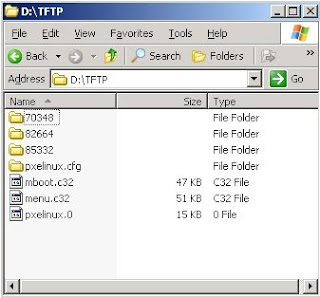
In the TFTP root pictured above I have 3 directories named after the ESXi build. The 'default' file in the pxelinx.cfg directory presents a menu so I can select which kernel to boot. I could also have a file in the pxelinux.cfg directory named after the GUID of the client, which would allow me to specify which kernel to boot for a particular client.
If you already have RIS / WDS in your environment, things are a little less clunky... can simply create a machine account in AD, enter the GUID of the box when prompted and then set the 'netbootMachineFilePath' attribute on computer object to the file on the RIS box that you want to boot.
Onto DHCP. Options 66 (TFTP server hostname) and 67 (bootfile name) need to be configured for the relevant scope. DHCP reservations for the ESXi boxen could also be considered a pre-requisite. The ESXi startup scripts do a nice job of picking that up and handling it accordingly.
So all this stuff is possible today (albeit unsupported). If ESXi doesn't have a filesystem for scratch space, it simply uses an additional 512MB of RAM for it's scratch - hardly a big overhead in comparison to the flexibility PXE gives you. Booting of an embedded USB device is cool, but having a single centralised image is way cooler. As you can see, there's nothing stopping you from keeping multiple build versions on the TFTP server, making rollbacks a snap. With this in place, you are halfway to a stateless infrastructure. New ESXi boxes can be provisioned almost as fast as they can be booted.
After booting, they need to be configured though... and that's where we move onto theory...
The biggest roadblock by far in making this truly stateless, is the lack of state management. There's no reason why VirtualCenter couldn't perform this function. But there's other stuff that would need to change too in order to support it. For example, something like the following might enable a fully functioning stateless infrastructure:
1) Move the VirtualCenter configuration store to Lightweight Directory Services (what used to be called ADAM), allowing VirtualCenter to become a federated, mutli-master application like Active Directory. The VMware Desktop Manager team are already aware that lightweght directory services make a _much_ better configuration store than SQL Server does. SQL Server would still be needed for performance data, but the recommendation for enterprises these days is to have SQL Server on a separate host anyway.
2) Enhance VirtualCenter so that you can define configurations on a cluster-wide basis. VirtualCenter would then just have to track which hosts belonged to what cluster. XenServer kind of works this way currently - as soon as you join a XenServer host to a cluster, the configurations from the other hosts are replicated to it so you don't have to do anything further on the host in order to start moving workloads onto it. This is probably the only thing XenServer does _way_ better than VI3 currently. Let's be honest - in the enterprise, the atomic unit of computing resource is the cluster these days, not the individual host. Additionally, configuration information could be further defined at a resource pool or vmfolder level.
3) Use SRV records to allow clients to locate VirtualCenter hosts (ie the Virtual Infrastructure Management service). Modify the startup process of ESXi so that it sends out a query for this SRV record everytime it boots.
4) Regardless of which VirtualCenter the ESXi box hit, since it would be federated it can tell the ESXi box which VirtualCenter host is closest to it. The ESXi box would then connect to this closest VC, and ask for configuration information.
By now all the Windows people reading this are thinking "Hmmm, something about that sounds all too familiar". And they'd be right - Windows domains work almost exactly in this way.
SRV records are used to allow clients to locate kerberos and LDAP services, ie Domain Controllers. The closest Domain Controller to the client is identified during the logon process (or from cache), and the client authenticates to this Domain Controller and pulls down configuration information (ie user profile and homedrive paths, group membership information for the user and machine accounts, Group Policy, logon scripts etc). This information is then applied during the logon process, resulting in the user receiving a fully configured environment by the time they logon.
I haven't had enough of a chance to run SCVMM 2008 and Hyper-V through their paces to see if they operate in this manner. If they don't, VMware can consider themselves lucky and would do well to get this functionality into the managment layer ASAP (even if it means releasing yet another product with "Manager" in the title :-).
If Microsoft have implmented this kind of functionality however, VMware needs to take notice and respond quickly. Given that the management layer will become more and more important as virtualisation moves into hardware, VMware can't afford to slip on this front.
Congratulations if you made it this far. Hopefully you've enjoyed reading and as always for this kind of post, comments are open!
I've mused several times on the whole stateless thing, especially with regards to ESXi, today I'm going to take it a bit further in the hope that someone out there from VMware may actually be reading (besides JT from Communities :-).
Previously I've showed how you can PXE boot ESXi. While completely unsupported, it at least lends itself to some interesting possibilities, as with ESXi, VMware are uniquely positioned to offer such a capability. The Xen hypervisor may be 50,000 lines of code but it's useless without that bloated Dom0 sitting on top of it. Check out the video (if you can be bothered to register, are they so desparate for sales leads that you need to register to watch a video???) of the XenServer "embedded" product - it still requires going though what is essentially a full Linux install, except instead of reading from a CD and installing to a hard drive it's all on a flash device attached the mainboard. But i digress...
So lets start at the top, and take a stroll through how you might string this ESXi stateless infrastructure together in your everyday enterprise. And I'll say upfront, I'm a Microsoft guy so a lot of the options in here are Microsoft centric. In my defense however, every enterprise runs Active Directory and it's easy to leverage some peripheral Windows technologies for what we want to achieve.
First up, the TFTP server. RIS (or WDS) is not entirely necessary for what we want to do - a simple ol TFTP server will do, even the one you can freely install from a Windows CD. In this example we'll use good ol' pxelinux, so our bootfilename will be 'pxelinux.0' and that file will be in the root of the TFTP server. The directory structure TFTP root could be something as follows:

In the TFTP root pictured above I have 3 directories named after the ESXi build. The 'default' file in the pxelinx.cfg directory presents a menu so I can select which kernel to boot. I could also have a file in the pxelinux.cfg directory named after the GUID of the client, which would allow me to specify which kernel to boot for a particular client.
If you already have RIS / WDS in your environment, things are a little less clunky... can simply create a machine account in AD, enter the GUID of the box when prompted and then set the 'netbootMachineFilePath' attribute on computer object to the file on the RIS box that you want to boot.
Onto DHCP. Options 66 (TFTP server hostname) and 67 (bootfile name) need to be configured for the relevant scope. DHCP reservations for the ESXi boxen could also be considered a pre-requisite. The ESXi startup scripts do a nice job of picking that up and handling it accordingly.
So all this stuff is possible today (albeit unsupported). If ESXi doesn't have a filesystem for scratch space, it simply uses an additional 512MB of RAM for it's scratch - hardly a big overhead in comparison to the flexibility PXE gives you. Booting of an embedded USB device is cool, but having a single centralised image is way cooler. As you can see, there's nothing stopping you from keeping multiple build versions on the TFTP server, making rollbacks a snap. With this in place, you are halfway to a stateless infrastructure. New ESXi boxes can be provisioned almost as fast as they can be booted.
After booting, they need to be configured though... and that's where we move onto theory...
The biggest roadblock by far in making this truly stateless, is the lack of state management. There's no reason why VirtualCenter couldn't perform this function. But there's other stuff that would need to change too in order to support it. For example, something like the following might enable a fully functioning stateless infrastructure:
1) Move the VirtualCenter configuration store to Lightweight Directory Services (what used to be called ADAM), allowing VirtualCenter to become a federated, mutli-master application like Active Directory. The VMware Desktop Manager team are already aware that lightweght directory services make a _much_ better configuration store than SQL Server does. SQL Server would still be needed for performance data, but the recommendation for enterprises these days is to have SQL Server on a separate host anyway.
2) Enhance VirtualCenter so that you can define configurations on a cluster-wide basis. VirtualCenter would then just have to track which hosts belonged to what cluster. XenServer kind of works this way currently - as soon as you join a XenServer host to a cluster, the configurations from the other hosts are replicated to it so you don't have to do anything further on the host in order to start moving workloads onto it. This is probably the only thing XenServer does _way_ better than VI3 currently. Let's be honest - in the enterprise, the atomic unit of computing resource is the cluster these days, not the individual host. Additionally, configuration information could be further defined at a resource pool or vmfolder level.
3) Use SRV records to allow clients to locate VirtualCenter hosts (ie the Virtual Infrastructure Management service). Modify the startup process of ESXi so that it sends out a query for this SRV record everytime it boots.
4) Regardless of which VirtualCenter the ESXi box hit, since it would be federated it can tell the ESXi box which VirtualCenter host is closest to it. The ESXi box would then connect to this closest VC, and ask for configuration information.
By now all the Windows people reading this are thinking "Hmmm, something about that sounds all too familiar". And they'd be right - Windows domains work almost exactly in this way.
SRV records are used to allow clients to locate kerberos and LDAP services, ie Domain Controllers. The closest Domain Controller to the client is identified during the logon process (or from cache), and the client authenticates to this Domain Controller and pulls down configuration information (ie user profile and homedrive paths, group membership information for the user and machine accounts, Group Policy, logon scripts etc). This information is then applied during the logon process, resulting in the user receiving a fully configured environment by the time they logon.
I haven't had enough of a chance to run SCVMM 2008 and Hyper-V through their paces to see if they operate in this manner. If they don't, VMware can consider themselves lucky and would do well to get this functionality into the managment layer ASAP (even if it means releasing yet another product with "Manager" in the title :-).
If Microsoft have implmented this kind of functionality however, VMware needs to take notice and respond quickly. Given that the management layer will become more and more important as virtualisation moves into hardware, VMware can't afford to slip on this front.
Congratulations if you made it this far. Hopefully you've enjoyed reading and as always for this kind of post, comments are open!
Wednesday, 14 May 2008
Get rid of that pesky VMware Tools update notification...
I have enough issues with the "VMware Tools out of date" notification appearing in the VI client every time an ESX patch is applied... it's almost useless information, as generally there are no support issues with running the RTM version of Tools regardless of the patch level of the host.
But even more annoying is the default behaviour of the VI 3.5 version of Tools, which enables a visual notification in the systray (on Windows guests) if an update is available, which is controlled by the checkbox below:
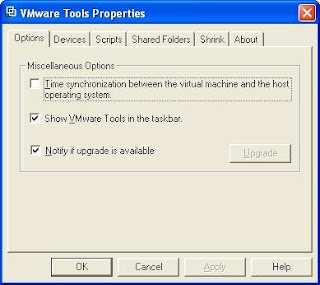
Too bad if you happen to certify particular driver (ie Tools) versions with coporate SOE versions, like every large enterprise on this planet does. And say goodbye to your standards when a bleary eyed admin sees this little yellow exclamation in the systray at 2am and gets the idea that upgrading VMware Tools may solve whatever problem they got woken up for. Hopefully they'll remember to raise a retrospective change request after some sleep. I won't even begin to imagine what the curious VDI user might do.
Fire up your registry monitoring tool of choice and clear the checkbox, and you will invariably be directed towards a modification in HKCU, meaning if you want to effect a machine wide change you would need to load the default user hive and mod the value in there, as well as the all users hive.
Good news is that you can more easily control the display on a machine wide basis by modifying the (default) value of 'HKLM\SOFTWARE\VMware, Inc.\VMware Tools'. Setting it to a DWORD value of 0 is the equivalent of clearing the checkbox (yes i know by default it's a REG_SZ - just turn it into a DWORD).
For anyone out there even half as lazy as me, copy this into your install script after the tools installer has been run:
REG ADD "HKLM\SOFTWARE\VMware, Inc.\VMware Tools" /V "" /T REG_DWORD /D "0x0" /F
But even more annoying is the default behaviour of the VI 3.5 version of Tools, which enables a visual notification in the systray (on Windows guests) if an update is available, which is controlled by the checkbox below:

Too bad if you happen to certify particular driver (ie Tools) versions with coporate SOE versions, like every large enterprise on this planet does. And say goodbye to your standards when a bleary eyed admin sees this little yellow exclamation in the systray at 2am and gets the idea that upgrading VMware Tools may solve whatever problem they got woken up for. Hopefully they'll remember to raise a retrospective change request after some sleep. I won't even begin to imagine what the curious VDI user might do.
Fire up your registry monitoring tool of choice and clear the checkbox, and you will invariably be directed towards a modification in HKCU, meaning if you want to effect a machine wide change you would need to load the default user hive and mod the value in there, as well as the all users hive.
Good news is that you can more easily control the display on a machine wide basis by modifying the (default) value of 'HKLM\SOFTWARE\VMware, Inc.\VMware Tools'. Setting it to a DWORD value of 0 is the equivalent of clearing the checkbox (yes i know by default it's a REG_SZ - just turn it into a DWORD).
For anyone out there even half as lazy as me, copy this into your install script after the tools installer has been run:
REG ADD "HKLM\SOFTWARE\VMware, Inc.\VMware Tools" /V "" /T REG_DWORD /D "0x0" /F
Tuesday, 13 May 2008
What VMware Site Recovery Manager isn't...
Straight up front - this is not a cynical post. My main point is NOT that SRM has some kind of product or design flaw. The reason for such a post is that there will be many people who will write about what SRM does offer, so I thought I'd balance it a little... to help people keep sight of the fact that it is not a panacea (not that it's purporting to be, but the marketing hyperbole is hardly going to point out why you need additional BCP / DR products). Personally I consider SRM a necessity, for the mere fact that keeping those BCP / DR VMs offline will save a fortune in system administration overheads associated with having them online, which are easily the biggest chunk of TCO. Enough of the disclaimers, onto the meat of the post!
When you think about why you would invoke a DR plan in the virtual world, it pretty much boils down to 2 things:
1) Catastrophes, like an entire datacenter or array outage.
2) Configuration errors that can't be recovered from within the application's RTO
Point 1 is obviously what SRM is designed to address, it is called Site Recovery Manager after all.
Point 2 however, is not what SRM can / should be used for, and one would certainly hope that configuration errors, like an OS or application patch that breaks something or a change request gone wrong, are much more probable than catastrophes.
Of course there are a number of ways you can address point 2. Snapshots can go some way towards it, but that can be very difficult in large enterprises where the VMware admins may not know about application changes in order to take the snap beforehand. You could schedule regular snaps and merges, effectively keeping VM's continuously in a snapshotted state, but I seem to recall something about SCSI reservations being used by VMFS to do metadata updates... stuff like extending a snapshot file when it gets written to - if you've got 20 VM's on a LUN that simultaneously kick off a virus scan which writes to a log as well as reads the entire filesystem, that might have some implications. Regular image level VCB backups could be used to similar effect, but you probably don't want to use SRM and take images of the entire virtual infrastructure. And as there's not really an elegant interface to track and manage specific VM image backups via VCB (at least not that I have seen), there's definitely room for the 3rd party tools that offer scheduled / asynchronous replication of an online production VM to an offline DR partner. If anything, it makes the need for their products more obvious.
So it's probably worth keeping the above in mind if you're coming up with a business case for putting SRM into your environment... include the need for a single VM rcovery solution as well if you don't have one already, to save getting caught out and then having to explain why that DR application you spent all that money on actually isn't the be all and end all.
When you think about why you would invoke a DR plan in the virtual world, it pretty much boils down to 2 things:
1) Catastrophes, like an entire datacenter or array outage.
2) Configuration errors that can't be recovered from within the application's RTO
Point 1 is obviously what SRM is designed to address, it is called Site Recovery Manager after all.
Point 2 however, is not what SRM can / should be used for, and one would certainly hope that configuration errors, like an OS or application patch that breaks something or a change request gone wrong, are much more probable than catastrophes.
Of course there are a number of ways you can address point 2. Snapshots can go some way towards it, but that can be very difficult in large enterprises where the VMware admins may not know about application changes in order to take the snap beforehand. You could schedule regular snaps and merges, effectively keeping VM's continuously in a snapshotted state, but I seem to recall something about SCSI reservations being used by VMFS to do metadata updates... stuff like extending a snapshot file when it gets written to - if you've got 20 VM's on a LUN that simultaneously kick off a virus scan which writes to a log as well as reads the entire filesystem, that might have some implications. Regular image level VCB backups could be used to similar effect, but you probably don't want to use SRM and take images of the entire virtual infrastructure. And as there's not really an elegant interface to track and manage specific VM image backups via VCB (at least not that I have seen), there's definitely room for the 3rd party tools that offer scheduled / asynchronous replication of an online production VM to an offline DR partner. If anything, it makes the need for their products more obvious.
So it's probably worth keeping the above in mind if you're coming up with a business case for putting SRM into your environment... include the need for a single VM rcovery solution as well if you don't have one already, to save getting caught out and then having to explain why that DR application you spent all that money on actually isn't the be all and end all.
Subscribe to:
Posts (Atom)